
Category: General
Your AI ROI Is Probably Wrong
The diligence problem that’s not being priced yet
The next wave of SaaS exits will sort companies into two groups. Those whose AI adoption made the asset more valuable, and those whose AI adoption made the asset harder to buy.
Most boards do not yet know which group they are in. The dashboards still show productivity gains, the headline savings still land. The buyer, eighteen months from now, will be looking at something else.
This piece is about the gap between those two views, and what to do about it before the gap becomes a discount.
The efficiency paradox
AI business cases tend to stop at the first term of the equation. They count the savings and move on. What they miss is what happens to the rest of the system when one function suddenly produces ten times its previous output.
Automating delivery without governing intent speeds up the cost line and slows down the revenue line. Code arrives faster, but it arrives without the thinking behind it. Reviewers slow down. Bugs pile up. The product gets harder to change. By the time the churn shows up in the dashboard, nobody is looking at the initiative that caused it.
The savings are local. The drag is systemic, and it compounds.
Fluidity and viscosity
Every organisation has a rate at which value moves from concept to customer. The ease of that flow is Fluidity. The friction that resists it is Viscosity.
A high fluidity system is lean and well documented, and it can be changed quickly because the reasoning behind it is recoverable. A high viscosity system looks productive but moves slowly. Every change needs reverse engineering. Every review becomes a forensic exercise. The system is thick.
AI automation, applied without governance, raises viscosity. It floods the pipeline with output that lacks the institutional intent behind it. The bottleneck moves from authoring to integration, and the people now stuck at that bottleneck are usually the ones you cannot easily replace.
The systemic ROI equation

Headline Value is the obvious figure. Payroll saved, contractors cut, time to first commit reduced. This is the number that gets into the board paper.
Ripple Costs are the second order effects on everything else. More QA time, senior engineer review fatigue, onboarding cost for the new shape of the work, infrastructure spend that scales with output volume rather than business value.
ARR Leakage is the capitalised cost of a product that becomes harder to maintain, more brittle, and less defensible. Most cases ignore it entirely, because it sits in the future and belongs to someone else’s quarter.
Ignoring ARR Leakage is the single most expensive mistake in AI ROI modelling.
A systemic case puts all three terms on the same page. Most don’t.
The initiative map
AI initiatives can be plotted on two axes: Headline Value, and Systemic Drag. The picture is more useful than the spreadsheet.
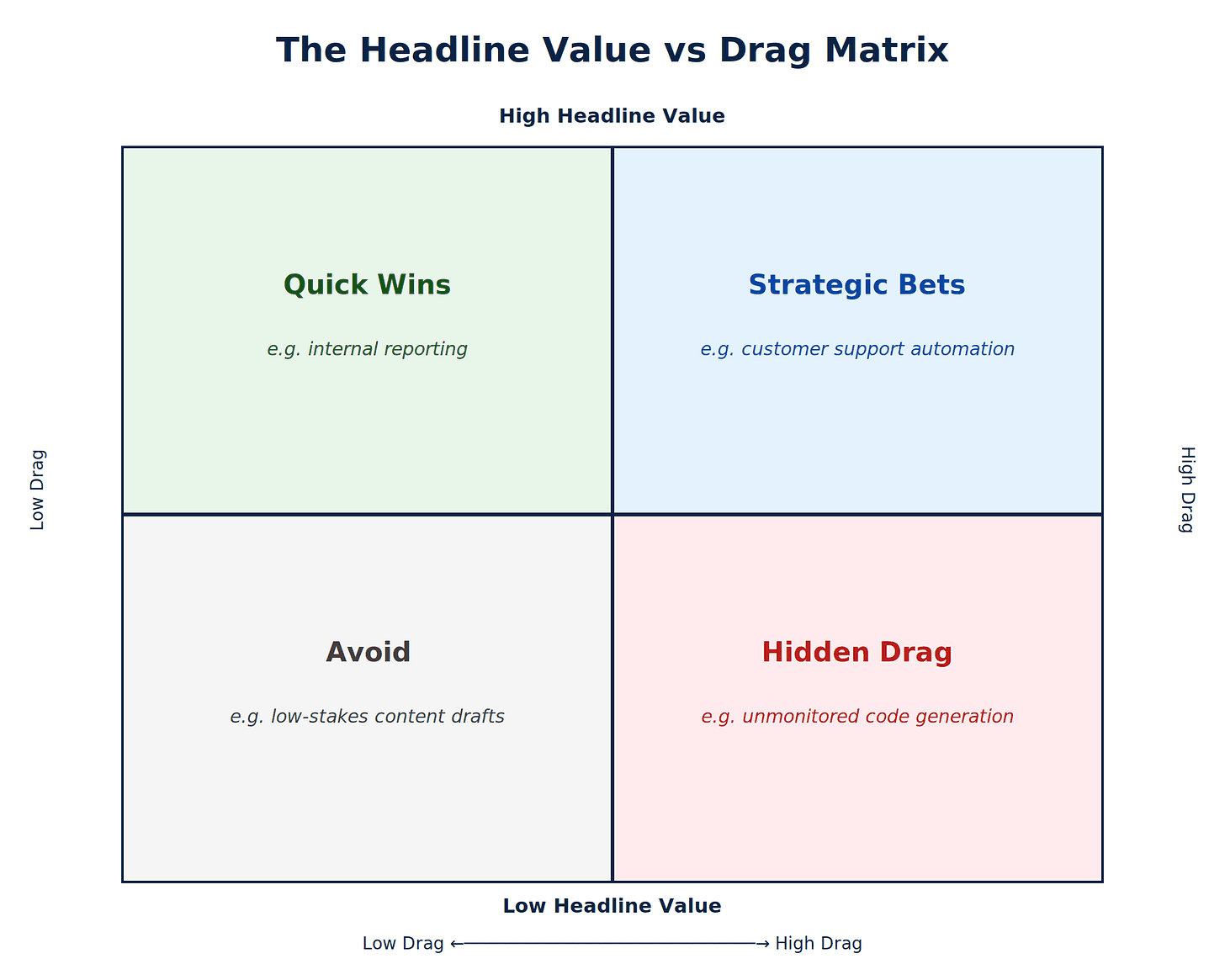
The dangerous quadrant is the top right. High Headline Value, High Systemic Drag. A lot of code generation, contract drafting, and outbound sales automation lives there. The first quarter produces defensible looking ROI. The next four quietly corrode the system underneath.
The map is a diagnostic. Plot your current AI portfolio on it, and the conversation about prioritisation changes shape.
Two questions most approvals miss
Approval processes ask the right questions about value, cost, risk, ownership, and architectural fit. They tend to miss two questions that turn out to matter most when the work is AI driven.
Where is the actual constraint
Visible friction is everywhere. Systemic friction is rare and decisive. An approval committee will happily green-light an initiative that automates the noisiest part of a process, even when the noise is not the bottleneck.
The result is familiar. The headline ROI lands, throughput does not move, and six months in somebody asks why the promised gains have not appeared. The answer is that the constraint was always somewhere else.
The question to add at approval: does this work target the actual constraint in the system, or the friction that happened to be easiest to automate? Where is the constraint, and what evidence supports that diagnosis?
A candidate that cannot answer this is automating optimistically.
Who absorbs the downstream load
Every business case names the upstream owner. Almost none names the downstream capacity. When an initiative raises output volume tenfold, the function that has to absorb that output (review, QA, integration, support, compliance check, customer success) does not stay the same size by default.
The result is a bottleneck that did not exist before approval and is invisible until delivery is well under way. The team running the automation is hitting its numbers. The team behind it is drowning. The numbers catch up eventually, usually as attrition in the absorbing function.
The question to add at approval: if output volume rises materially, which function absorbs the downstream load, and has that capacity been confirmed at the new volume?
The early warning system
Approval depends on three live sensors. Without them, the initiative is flying without instruments.
Review to authoring ratio. Time spent reviewing AI output against time spent authoring. If review time exceeds the human baseline, the output is too thick for the system to absorb. One PE backed SaaS we watched crossed this threshold in week three and only noticed at month nine. By then the engineering team had stopped trusting the tool and was rewriting most of its output by hand. The headline savings were intact on paper, but the actual throughput had collapsed.
Context recovery time. How long it takes a developer to explain the reasoning behind an AI generated segment. When this number grows, institutional memory is being transferred from the team to the tool, and the tool cannot be cross examined. The first time a senior engineer leaves a system in this state, the cost of replacement is closer to a rebuild than a handover.
Regression density. The rate of new bugs in modules touched by automation, compared with legacy code. Rising regression density is the earliest reliable signal that automation is producing volume without coherence. Without this sensor, the symptom shows up as customer complaints, then as churn, then as a board question that has no good answer.
The kill switch
Sensors are useless without thresholds. Approval has to include the conditions under which the initiative gets paused.
A workable default looks like this. If QA cycles increase by more than twenty percent, or regression density rises by more than fifteen percent against the legacy baseline, or context recovery time exceeds the agreed limit, the initiative is paused for human refactoring. No overrides without board level sign off.
A kill switch works mainly by changing how the people running the initiative behave. They make tighter decisions when they know the threshold is real.
The private equity lens
All of this maps onto exit readiness, and it maps directly.
Viscosity is a diligence problem. Buyers do not pay full multiples for codebases nobody can explain. An intent vacuum is a key person risk. If the reasoning behind half the system lives in a tool rather than a team, the team is not actually transferable. Regression density is a quality of earnings flag in engineering clothes. Recurring revenue from a product that is becoming harder to maintain is recurring revenue with a discount applied.
The window for AI adoption to act as a value creation lever is narrow. Companies that govern it well over the next two years will exit at premium multiples. Companies that confuse activity with progress will find the costs already capitalised into the buyer’s offer.
The CEO question is no longer “are we using AI”. It is “is our use of AI moving the number, and can we prove it”.
The architects of fluidity
In a market where AI driven execution is becoming a commodity, the durable advantage lies in producing output the system can absorb without seizing up.
The companies whose every line of code, human or machine, carries the institutional intent required for long term growth, retention, and exit will win. Call them the architects of fluidity. They have worked out that AI does not change the laws of organisational physics. It just makes them more expensive to ignore.


