
Category: AI
The Room Is the Problem
Why your thinking mode leads to failure
Somewhere right now, a mid-market SaaS business is running an AI brainstorm. Two rooms, probably. One is thinking about internal efficiency: where can we cut headcount, speed up support, automate the reporting nobody reads. The other is thinking customer-facing: what can we bolt onto the product that lets us put “AI-powered” on the website before the next board meeting.
Both rooms will produce a list. Both lists will get funded. And on current evidence, nineteen times out of twenty, neither will produce a return anyone can point to eighteen months from now.
That’s not a guess. MIT’s Project NANDA studied over 300 enterprise AI deployments, ran 52 structured interviews, and surveyed 153 senior leaders across the industry. Their finding: 95 per cent of generative AI pilots fail to deliver measurable financial returns. Companies have poured somewhere between $30 and $40 billion into this, and the machine that’s supposed to be eating the world has, for the vast majority of buyers, eaten the budget and nothing else.
*Note: The 95% varies wildly. The number is not as important as the why.
A separate S&P Global survey of over a thousand enterprises found much the same shape from a different angle. In 2025, 42 per cent of companies abandoned most of their AI initiatives, up from 17 per cent the year before. The average business scrapped nearly half its AI proof-of-concepts before they got anywhere near production.
Everyone has a favourite explanation for this. The model wasn’t good enough. The data was a mess. Change management failed. All of these get some credit, and none of them is the root cause. I think the root cause is upstream of all of it, sitting in the room where the project got picked in the first place.
The room decides badly before the model ever gets a chance
Here’s the pattern. Someone convenes a group, internal ops, or customer experience, or “the AI taskforce,” and asks a version of one question: where could AI help us?
That’s the wrong question. It invites the room to search for places where a capability might apply, rather than for the thing that’s actually constraining the result they want to change. Give a group of smart, well-meaning people an impressive new capability and ask them to find uses for it, and they will. Every process in the building can be described as “could go faster with AI.” That description tells you nothing about whether that process was ever the thing holding the business back.
The MIT data shows exactly where this leads. Over half of AI budgets in 2025 went to sales and marketing pilots, the visible stuff, the stuff you can show a board slide about. The actual returns came from back-office automation instead, the unglamorous processes nobody wanted to brainstorm about because nobody gets excited pitching invoice reconciliation. The money followed the enthusiasm in the room. The value was sitting somewhere else entirely.
This is a fairly ordinary description of groupthink. Irving Janis identified the conditions that produce it back in the 1970s: a cohesive group, insulated from outside challenge, converging on a shared judgement faster than the evidence warrants. AI taskforces are almost engineered to hit every one of those conditions. Same people, same incentives, same excitement about the same demo everyone saw last month. Nobody in the room is rewarded for being the person who says “hang on, why do we think this is the constraint.”
There’s a second data point that backs this up. MIT found that AI pilots built with a mix of internal specialists and outside expertise succeeded 67 per cent of the time. Pilots built entirely in-house, by IT alone, succeeded 22 per cent of the time. That’s not a small gap and the only variable that changed was whether an outside voice was in the room to disagree.
Change the question
I use a different starting question, borrowed more or less directly from Eliyahu Goldratt’s Theory of Constraints. “What is actually stopping the metric we want to move.” Those sound similar. They lead to completely different projects.
The sequence looks like this:
Find the constraint that’s binding the metric you care about. Not a process that feels slow. The thing that, if you fixed it tomorrow, would actually change the number.
Check whether there’s a non-AI fix for that constraint first. Sometimes the constraint is a broken handoff between two teams, or a policy nobody’s revisited in five years, or a form that asks for the same information three times. AI is an expensive way to paper over a process problem you could solve with a decision.
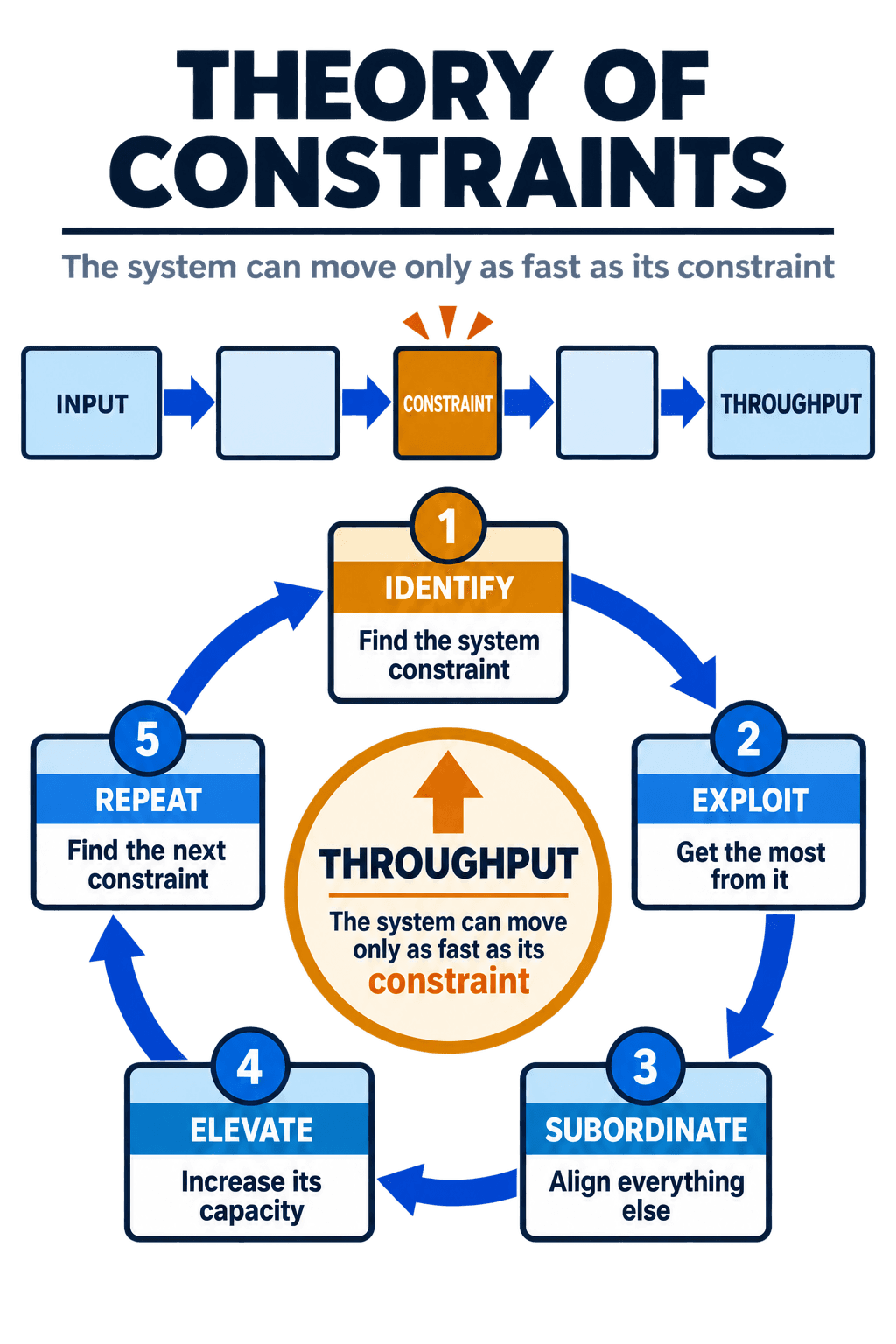
If AI genuinely is the answer, work out how it changes the business, not just the task. A model that removes a bottleneck changes what flows through the system downstream of it. That has consequences for the people, the controls, and the next constraint in line, which is now somewhere else.
And if the fix involves removing people, work out what happens to the job functions of the people who stay. Work doesn’t vanish when you cut headcount. It redistributes. If it redistributes badly, you’ve traded a constraint you understood for one you haven’t found yet.
None of this happens naturally in a brainstorm. It happens through data, through actually looking at where queue time, rework, and decision latency are piling up, and then testing whether that constraint survives scrutiny. The room’s job shifts from generating ideas to stress-testing a hypothesis someone brought in from outside the enthusiasm. That’s a much less fun meeting. It’s also, on the evidence, roughly three times more likely to work.
The second layer
There’s a second layer to this that the brainstorm format is particularly bad at surfacing. It’s the set of questions that only produce answers you don’t want to hear.
If we build this workflow around a foundation model, what happens if our access gets restricted. What happens if the provider changes terms, or has an outage during the one week a year we actually need this thing to work, or simply prices differently next year than this year. What happens if the foundation company itself doesn’t make it, and I don’t mean that as a remote scenario in an industry burning cash at the rate this one is.
None of these questions belong in a brainstorm, because a brainstorm is optimised for producing ideas and these questions kill ideas. That’s precisely why they get skipped. But they’re exactly the questions a board should want answered before capital gets committed to a process redesign that now runs through a single external vendor with no fallback path. If your workflow’s constraint resolution depends entirely on one model provider staying priced, available, and in business, you haven’t removed a constraint. You’ve swapped an internal one you understood for an external one you haven’t stress-tested, and called it progress.
Where this leaves you
I don’t think the 95 per cent failure rate is a story about AI being oversold, though plenty of it has been. I think it’s a story about decision architecture. Most organisations are still picking AI projects the way they’d run an ideas competition, and ideas competitions reward the most exciting pitch, not the most binding constraint.
The fix isn’t a better brainstorm. It’s removing the brainstorm as the primary selection mechanism and replacing it with something closer to an audit. Find the constraint in the data. Bring in a voice that isn’t already invested in the answer. Ask the questions that don’t generate enthusiasm before you ask the ones that do.
The 5 per cent of pilots that actually work are succeeding because somewhere before the model got chosen, somebody in the room was allowed to say the project was a bad idea, and the project changed because of it.
Sources
MIT NANDA, The GenAI Divide: State of AI in Business 2025 (Project NANDA, July 2025). Based on a review of 300+ publicly disclosed AI initiatives, 52 structured interviews, and 153 senior leader survey responses.
S&P Global Market Intelligence, enterprise AI adoption survey, 2025 (survey of 1,000+ enterprises).
Irving L. Janis, Victims of Groupthink (Houghton Mifflin, 1972), for the original conditions and mechanics of groupthink.
Eliyahu M. Goldratt, The Goal (North River Press, 1984), for the Theory of Constraints framing.

